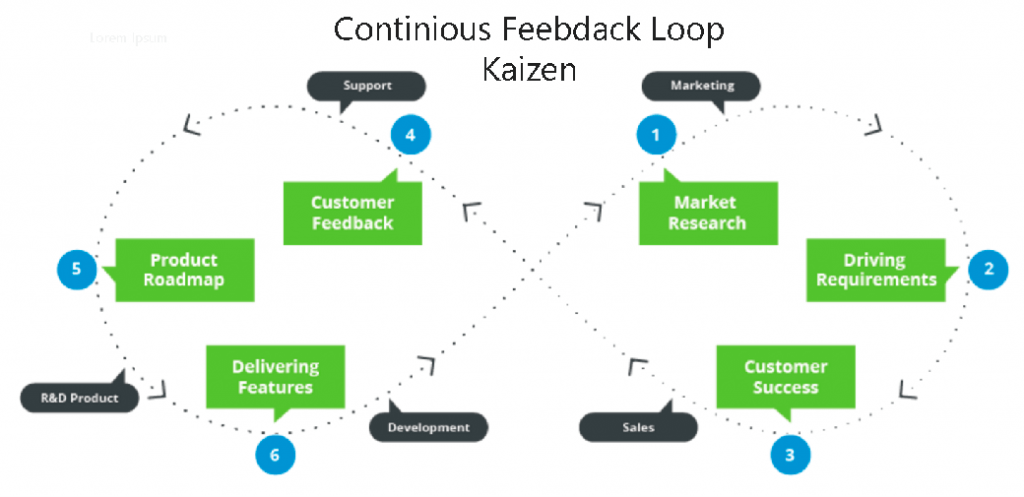
In the modern digital economy, customer feedback is gold—but it’s only valuable when captured, analyzed, and acted upon in a timely manner. This is where Customer Relationship Management (CRM) systems play a transformative role. A well-integrated CRM can significantly enhance product feedback loops, allowing businesses to gather insights directly from customers, close the loop with development teams, and make informed decisions that accelerate innovation.
This article explores how CRM platforms improve the speed, quality, and impact of product feedback loops, helping companies build better products, increase customer satisfaction, and reduce churn.
1. What Is a Product Feedback Loop?
A product feedback loop is a cyclical process that involves:
- Collecting feedback from users
- Analyzing feedback to identify trends and issues
- Implementing changes based on insights
- Following up with customers to verify satisfaction
This iterative approach ensures that product development is aligned with real user needs. A CRM strengthens each stage of the loop by providing structure, automation, and centralization.
2. Centralized Feedback Collection
CRMs act as a single repository for all customer interactions, which is essential for collecting product feedback at scale. CRM systems can gather feedback through:
- Customer service tickets and chat logs
- Sales team notes and call recordings
- Post-purchase surveys and NPS responses
- Website forms and live chat
- Social media integrations
Every piece of feedback is attached to a customer profile, giving teams full context on who said what, when, and why.
3. Real-Time Visibility for Product Teams
With a CRM, product teams gain immediate access to live customer feedback without relying solely on periodic reports or surveys. Key features that support this include:
- Custom dashboards showing trending issues or feature requests
- Tagging and categorization of feedback by topic, urgency, or segment
- Automated alerts for critical feedback or patterns
- Cross-team visibility, allowing product, support, and sales to collaborate
This real-time access empowers product managers to respond quickly to user needs, improving agility and reducing time-to-market.
4. Segmented Feedback Analysis
Not all feedback carries equal weight. CRM platforms allow you to segment feedback by:
- Customer tier (e.g., enterprise vs. SMB)
- Product plan or version
- Region or language
- Industry
- Revenue potential
This helps product teams prioritize features or fixes that matter most to high-value or strategic customer segments—leading to smarter resource allocation.
5. Automating Feedback Capture Through CRM Workflows
CRM systems can automate the feedback collection process, ensuring consistent and timely input. Examples include:
- Sending post-interaction surveys after support tickets close
- Triggering feature request forms after product demos
- Following up after product updates or beta releases
- Collecting NPS or CSAT scores at scheduled intervals
These workflows ensure that customer insights are gathered without manual effort, increasing the volume and reliability of data.
6. Closing the Loop with Customers
One of the biggest failures in product development is not informing customers when their feedback leads to a change. CRMs can automate closed-loop communication by:
- Notifying customers when their issue is resolved
- Announcing new features based on submitted requests
- Thanking users for feedback with personalized messages
- Re-engaging users with improved product versions
This transparent communication builds trust and loyalty, making customers feel heard and valued.
7. Enabling Data-Driven Roadmap Decisions
CRMs store and visualize feedback data in ways that make it actionable for product teams. Integration with BI tools or native reporting dashboards enables:
- Tracking the number of requests for a specific feature
- Measuring sentiment over time
- Calculating churn risk tied to product issues
- Identifying top contributors of product ideas
This data-backed approach to roadmap planning leads to products that are better aligned with user expectations and market demands.
8. Collaboration Between Customer-Facing and Product Teams
CRMs foster cross-functional collaboration by making it easy to share customer insights. For example:
- Support teams tag feedback directly in the CRM
- Sales reps flag repeated objections during demos
- Product managers review aggregated reports from CRM data
- Marketing teams analyze customer sentiment to refine messaging
By breaking down silos, CRM ensures that feedback flows smoothly across departments, strengthening the entire product lifecycle.
9. Integrating CRM with Feedback and Development Tools
To fully close the feedback loop, CRM systems can integrate with:
- Productboard, Aha!, or Jira – for pushing customer feedback directly into product roadmaps
- Survey tools like Typeform or SurveyMonkey – to feed responses into CRM
- Support platforms like Zendesk or Intercom – syncing feedback into customer records
- Analytics platforms like Tableau or Power BI – for advanced feedback trend analysis
These integrations create a unified feedback ecosystem, where insights drive continuous improvement.
10. Measuring the Impact of Feedback on Product Success
One of the most powerful CRM capabilities is tracking the ROI of product changes based on feedback. Using your CRM, you can measure:
- Reduction in support ticket volume post-feature release
- Increase in retention or upsells after customer-requested improvements
- Engagement and adoption rates of new features
- Satisfaction score improvements over time
With these insights, teams can prove the value of customer-driven development, validating their product strategy and gaining internal alignment.
Conclusion: CRM Is the Engine of Effective Feedback Loops
In an age where customer experience defines brand success, feedback isn’t optional—it’s mission-critical. A CRM system doesn’t just store contact information; it becomes the backbone of a continuous improvement process. It ensures that product decisions are rooted in real user experiences, not assumptions.
By leveraging CRM to enhance your product feedback loop, you create a culture where:
- Customer voices are captured and respected
- Product updates are timely and relevant
- Teams collaborate seamlessly to deliver innovation
- Your business evolves with your users—not ahead or behind them
Implementing CRM-driven feedback loops is not just smart—it’s essential for companies that want to remain competitive, agile, and customer-focused.